
Guardians of Trust: My Takeaways from Swiss Testing Day 2026
Category: QA Methodology | Automation & AI
Date: April 2026
Reading time: 8 minutes
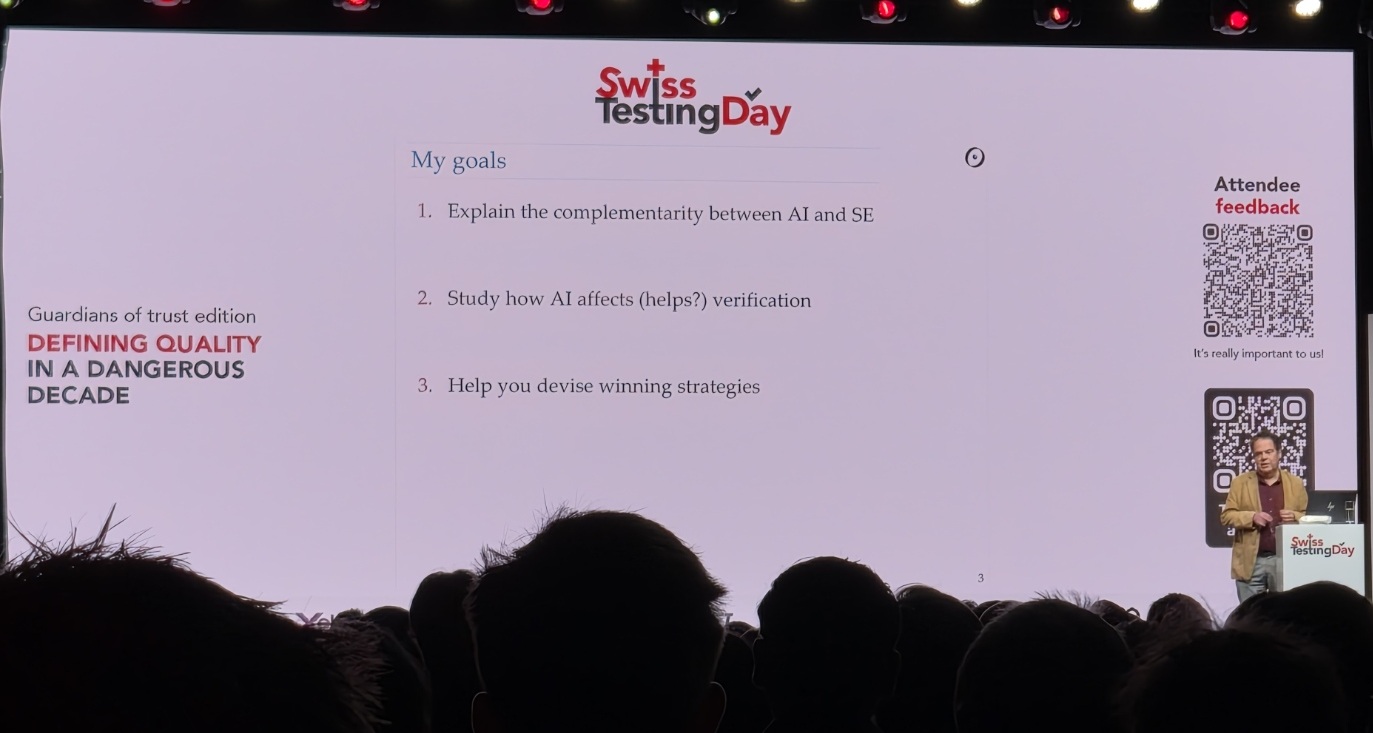
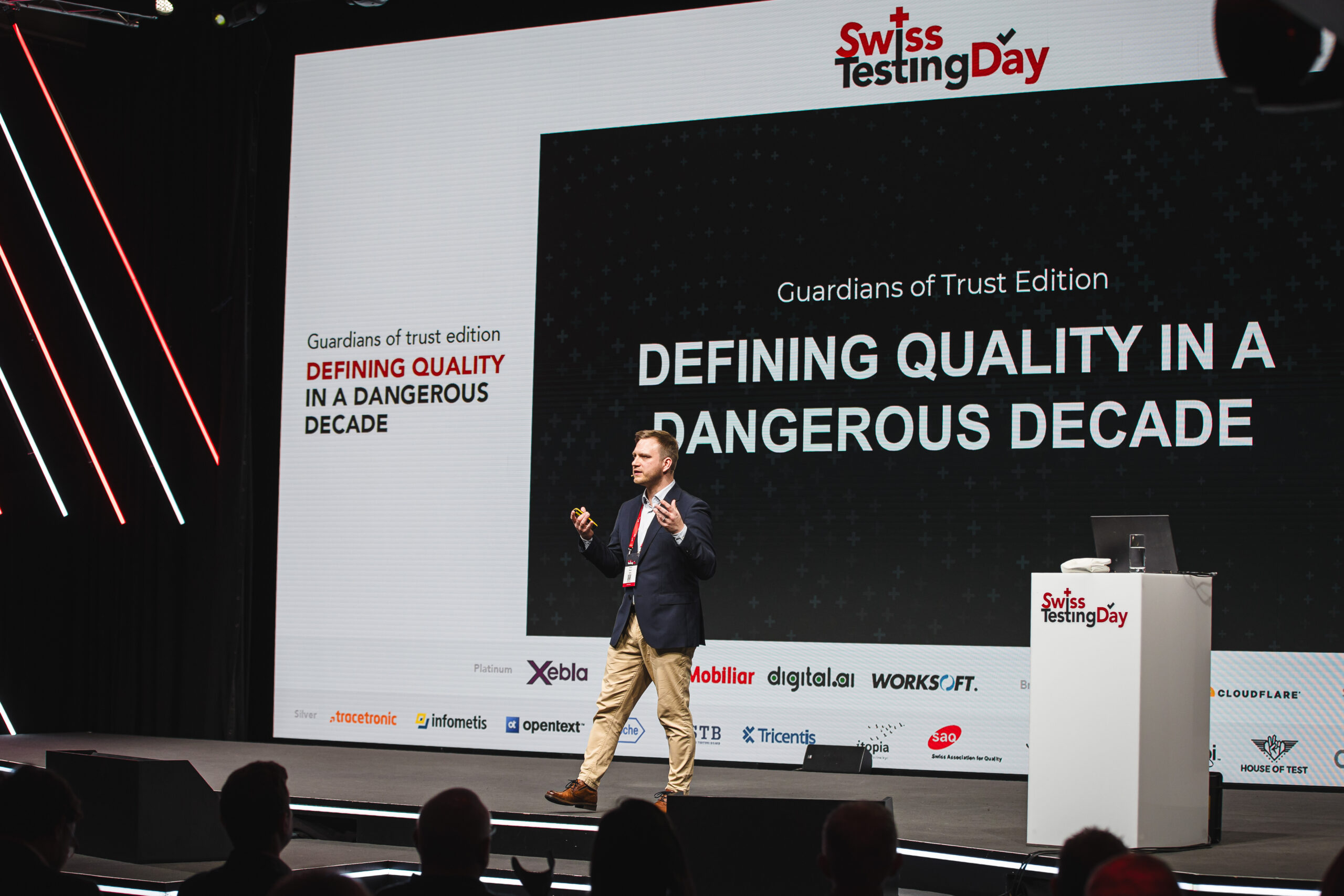
On March 26, 2026, I was in Zurich for Swiss Testing Day.
"Guardians of Trust" edition. Subtitle: "Defining Quality in a Dangerous Decade". Over 400 QA professionals gathered at StageOne for a full day. Keynotes, sessions, debates. And above all, one central question that kept coming up in every room, every hallway conversation:
What does AI actually change for us?
Here's what I took away from it. Not an exhaustive summary. My realizations, my reflections, what shifted in the way I see things.
Coding is 10 to 20% of the job
The opening keynote was given by Bertrand Meyer. For those who don't know him: he's the creator of the Eiffel programming language, a pioneer of Design by Contract, and a researcher who has been working on software verification for decades.
His starting point was simple and striking.
If AI can code for us... so what? Coding only represents 10 to 20% of software engineering. The rest is requirements engineering, architecture, design, validation, verification, testing, debugging, maintenance, project management.
Put differently: even if AI writes all the code in the world, 80% of the work remains.
And that's where things get interesting.
Two types of technological breakthrough
Meyer introduced a distinction I had never articulated this clearly before.
There are skill-leveling technologies: they make a skill accessible to more people. Autofocus in photography, AutoCAD in architecture. Before, it took years to master manual focus. Today, anyone can take a sharp photo.
And there are skill-enhancing technologies: they make experts even better. Object-oriented programming, GPUs for computation, intelligent autocompletion. These tools don't replace expertise. They amplify it.
Generative AI is both at once.
For a junior, it's skill-leveling. It allows them to produce functional code without mastering all the fundamentals. For a senior, it's skill-enhancing. It accelerates repetitive tasks and frees up time for architecture and design decisions.
But this duality also creates a trap.
The fantasy of getting rid of developers
It's not the first time someone has announced the end of developers.
Low-code. No-code. Website generators. With every technological wave, the same promise comes back: we won't need people who code anymore.
And every time, reality catches up with the fantasy.
Why? Because telling a machine what you want isn't enough. In real life, requirements are vague, contradictory, incomplete. Defining them, structuring them, prioritizing them is a job in itself. The job of a project manager, a product owner, a business analyst.
Even with an AI capable of writing perfect code, the fundamental question remains: perfect code... to do what exactly?
That's the difference between tactical progress and strategic progress. AI excels at the tactical. It generates, it completes, it accelerates. But the strategic -- understanding the problem, defining the direction, making trade-offs -- that remains human.
Mephistopheles in your IDE
One of the most striking moments of the keynote: the reference to Faust.
Meyer displayed an illustration of Mephistopheles with a quote from Goethe's Faust. The message was clear: AI is a seductive assistant that always says yes.
And that's exactly the problem.
AI doesn't know how to say "stop". It doesn't realize when it's making a mistake. If you ask it to fix a bug, it will add code on top of existing code. If the fix creates a new problem, it will add more code. Layer after layer, fix after fix, it builds spaghetti code without ever stepping back.
Worse: it ends up hallucinating on its own hallucinations. It invents solutions to problems it created itself, with complete confidence in its response.
The Faustian bargain, 2026 edition: more speed, less control.
When AI is the system under test
A point that particularly struck me as a QA professional: how do you test a system whose behavior is non-deterministic?
With traditional software, I can define inputs and verify expected outputs. With generative AI, the same prompt can produce different results on every execution. Traditional test oracles no longer work.
The answer Meyer brought up: metamorphic testing. Instead of verifying a specific result, you verify relationships between results. If I double the amount of input data, does the trend in the output remain consistent? If I rephrase my question, does the answer remain semantically equivalent?
It's a paradigm shift for testing. We move from "is the answer correct?" to "is the behavior consistent?".
Contracts, proofs and tests: the winning trio
Meyer dedicated part of his keynote to software contracts -- preconditions, postconditions, invariants. His historical area of expertise with Eiffel.
His argument: formal proofs and tests are not in opposition. They reinforce each other. You can use a prover to generate test suites with 100% coverage. Contracts serve as a living specification that guides both development and verification.
He cited a paper by Li Huang, Manuel Oriol and himself on combining tests and proofs for better software verification. The underlying message is strong: in a world where AI generates code, proofs must accompany tests at every moment. We can no longer afford to trust code without formal verification.
"Barbell Hiring": a threat to mid-level profiles
The section on individual strategies spoke to me directly.
Meyer described a phenomenon he calls "Barbell Hiring". Companies, facing AI, may adopt a barbell hiring strategy: lots of very junior profiles (cheap, AI-assisted) and a few very senior profiles (experts, architects). The middle of the bar? Empty. Mid-level profiles, those with 3 to 7 years of experience, would be the most at risk.
It's a wake-up call.
If you're in that range, your strategy can't be "do the same thing as before but with ChatGPT". You need to level up on what AI doesn't do: systems thinking, test strategy, quality culture, the ability to define the "what" and the "why" before the "how".
We are still responsible for our code
Meyer's closing slide was a single sentence. And it might be the most important one of the entire conference.
You are still responsible for the code.
Whether the code is written by us, by a junior, by a contractor or by an AI, the responsibility remains the same. Quality, robustness, maintainability, extensibility: all of that is our problem.
And that's precisely why QA has never been more important. Not as a step at the end of a pipeline. As a culture. A way of thinking. A discipline that runs through the entire development cycle.
What this changes for me
I had a computer science teacher who used to repeat something that stuck with me. He said there was no point getting into IT without passion. Because when others go home and hit the gym or watch TV, the ones with passion create, build, code. And that experience will always beat academics.
He was right. And with AI in the equation, it's even more true.
AI is not going to replace QA professionals. It's going to replace those who just execute test cases without understanding why they exist. Those who never had the curiosity to look at how the system works beyond their own scope.
Manual testers with no interest in tech, those who don't want to hear about automation or code, they're the ones at risk. And let's be honest: working in IT without wanting to learn the basics of your own field means being bad at your job. The problem existed long before AI. AI just makes it visible.
Swiss Testing Day is the leading conference in Switzerland for software testing and QA. The 2026 "Guardians of Trust" edition was held on March 26 in Zurich.
I regularly share my experience and reflections on this blog and on LinkedIn. Feel free to reach out if these topics resonate with you.